
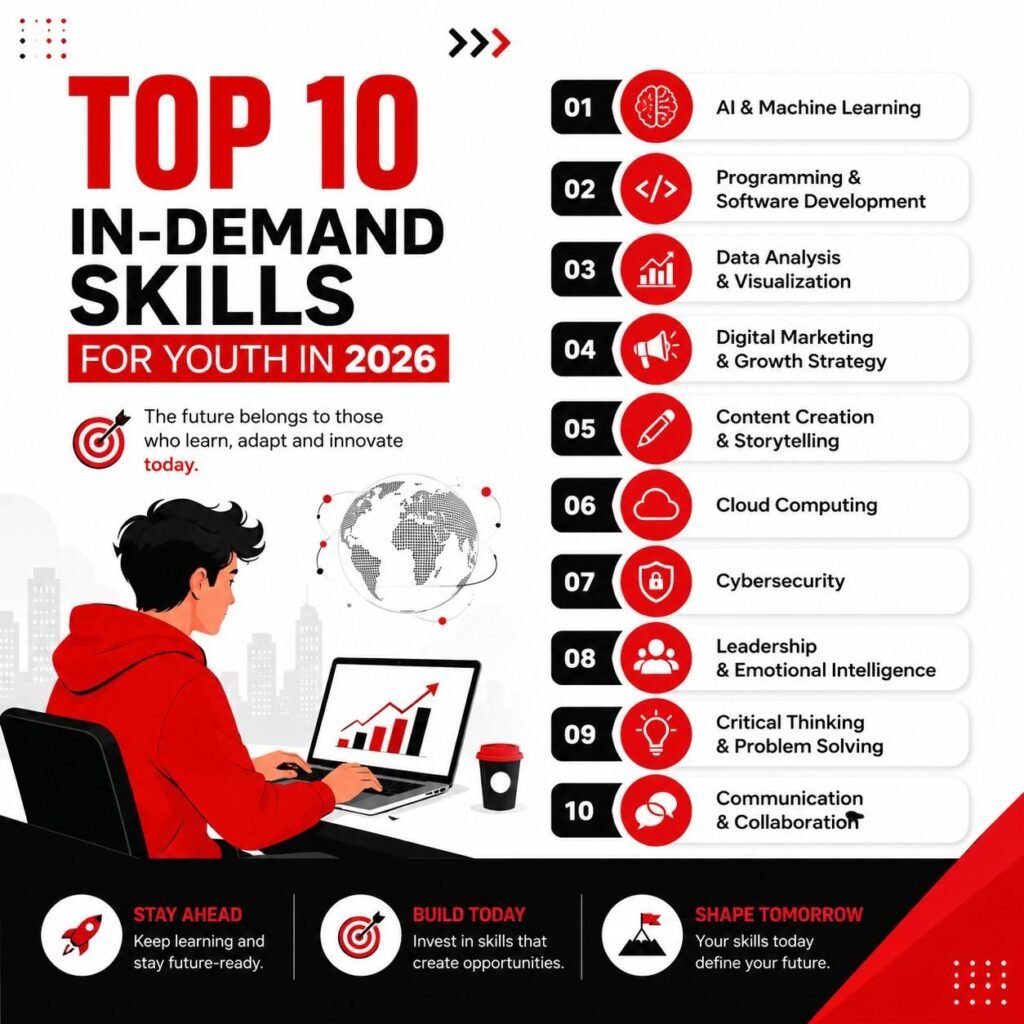
Here’s the thing about the top 10 in-demand skills for youth lists you see everywhere. Most of them are written by people who don’t hire. Or they’re written by recruiters who can copy-paste a job description but couldn’t tell you what the job actually feels like at 3 PM on a Tuesday.
I’ve been in the trenches for 15 years. Building teams. Firing people. Training juniors who became VPs. And I can tell you flat out: the in-demand skills for youth market shifted hard between 2020 and 2026. Harder than any five-year span I’ve seen.
So I looked at the data. I talked to founders. I analyzed where money is flowing. Here’s the real top 10 in-demand skills for youth in 2026. No filler. No “synergy.” Just the stuff that actually matters.
Why the Market Is Punishing “Normal” Right Now
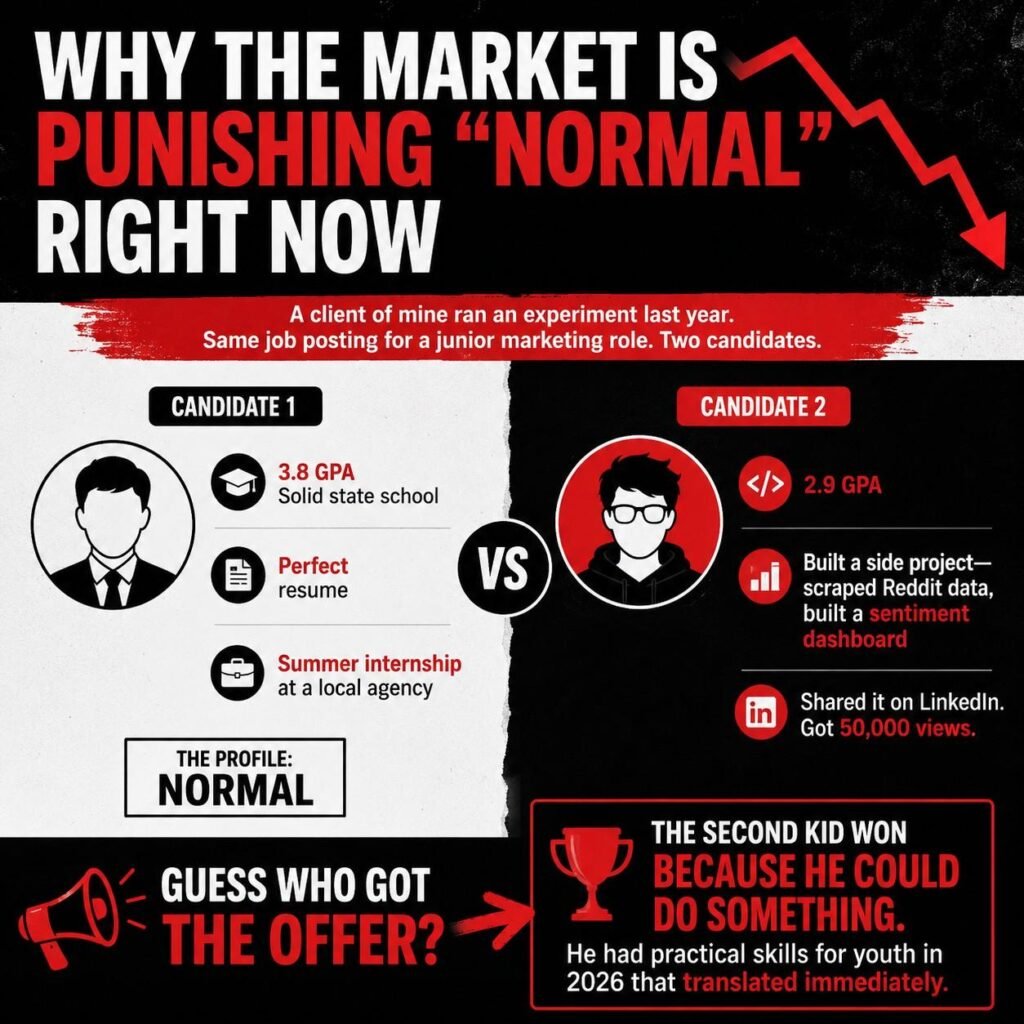
A client of mine ran an experiment last year. Same job posting for a junior marketing role. Two candidates.
One had a 3.8 GPA from a solid state school. Perfect resume. Had done a summer internship at a local agency.
The other kid had a 2.9 GPA. But he’d built a side project—scraped Reddit data, built a sentiment dashboard, and shared it on LinkedIn. Got 50,000 views.
Guess who got the offer?
The second kid won because he could do something. He had practical skills for youth in 2026 that translated immediately.
This is the throughline of the entire list. It’s not about what you know. It’s about what you can do with what you know. And this list of top 10 in-demand skills for youth reflects that brutal reality.
Top 10 In-Demand Skills for Youth in 2026:
1: AI Fluency (Not Just Prompt Writing)
Everyone can ask ChatGPT to write an email. That’s not a skill anymore. That’s breathing.
Real AI fluency means something different. It means you understand failure modes. You know what a hallucination looks like. You can build a workflow instead of just firing off one-off prompts.
I remember training a junior last year. She noticed the AI kept hallucinating citations. Most people would just shrug. She built a verification layer into the workflow. She didn’t wait for permission.
That’s the difference maker. In my experience, this is the single most in-demand skill for youth right now. The ability to talk to machines, audit their work, and build systems around them.
2: Systems Thinking
The world is tangled. Change one variable, everything moves.
Young professionals who can zoom out and ask “how does this actually work?” are rare. Like, unicorn rare.
A Google study on Project Oxygen found that the highest-performing teams weren’t the smartest. They were the ones who understood context.
I had a junior analyst years ago. Everyone else was fixing spreadsheet errors. She drew a map of why the errors existed. She traced the upstream dependencies. She got promoted in six months.
This is a recurring theme in the top 10 in-demand skills for youth list. The common thread is context. Understanding the system, not just your tiny corner of it.
3: Data Storytelling
You can learn Excel in a weekend. Python is common now.
But can you take a messy dataset and make a CEO care? That’s rare.
Most people dump a chart on a slide. The skilled person says, “This dip here? That’s because our competitor launched. But look at the recovery. Here’s why we won.”
This in-demand skill for youth in 2026 directly ties to revenue. If you can’t explain the story behind the numbers, you don’t get the budget.
Skill #4: Adaptability (The Meta-Skill)
I know. “Adaptability” sounds like something an HR person puts on a poster. Let me reframe it.
Adaptability isn’t about pivoting smoothly. It’s about not panicking when the rug gets pulled.
I’ve seen juniors fall apart over a Slack message that was mildly critical. I’ve seen others take a layoff and start a freelance business the same week.
The second group wins. Every time.
In the top 10 in-demand skills for youth, this is the hardest to teach. But it’s the easiest to spot. And it pays the most.
5: Communication & Collaboration (For Real)
Remote work exposed a lot of people. Not because they couldn’t code or analyze. Because they couldn’t write a clear async message.
If you can explain a complex idea in a Slack message that doesn’t need three follow-up questions, you’re in the top 1%.
I don’t care if you’re a coder, a designer, or a salesperson. If you can’t communicate, you’re a liability. This is a core in-demand skill for youth that gets drowned out by the flashy stuff.
6: Digital Marketing and Personal Branding
“I’m a biologist. Why do I need marketing?”
Because your career is a product. You are the CEO of your own tiny company.
Young people who understand SEO, content creation, and audience building have a 10x advantage. They don’t apply for jobs. They get found.
Knowing the basics of how attention works is one of the most overlooked in-demand skills for youth. It builds your leverage. It builds your network. And it builds your bank account.
7: Project Management (Fluid, Not Rigid)
Not everyone will be a “Project Manager” on paper. But every role is a project.
Know how to set a sprint goal. Know how to run a standup. Know how to close a loop.
A lot of young hires struggle with this. They wait for instructions. The top 10 in-demand skills for youth in 2026 punishes passivity.
If you can manage your own time and a small team’s time without handholding, you are invaluable.
8: Cybersecurity Fundamentals
You don’t need to be a white-hat hacker. But you need to know how not to get your company hacked.
Phishing awareness. Password hygiene. Basic data privacy principles.
Every company is a tech company now. And tech companies are under constant attack. If you’re the junior person who spots the security flaw, you instantly become the most valuable person in the room.
This is a skill for youth in 2026 that’s only going to grow in importance.
9: Emotional Resilience
The internet is loud. The economy is volatile. Layoffs are everywhere.
The young professionals who survive are the ones who can hold their nerve.
I see a lot of burnout. Juniors who take every piece of feedback as a personal attack. People who compare themselves to the 25-year-old “CEO” on TikTok and feel like failures.
If you can manage your own psychology, you win. This is the dark horse of the top 10 in-demand skills for youth.
10: Sales (The Human Kind)
Not cold calling. Just conviction.
Sales is the ability to make someone believe in an idea. You need this to get hired (sell yourself), to pitch a project (sell the idea), to get promoted (sell your value).
If you can handle a “no” and still move forward, you’re dangerous. This completes the top 10 in-demand skills for youth list because it’s the one skill that connects everything else.
The Big Question: Coding vs. Everything Else?
“Should I just learn to code?”
I used to say yes, every time. Now? It depends.
If you enjoy it, yes. If you hate it, find something else.
In 2026, the highest-paid people aren’t the pure coders. They’re the ones who use code as a tool for a specific domain problem. A nurse who builds an app for patient intake. A barista who automates inventory management. A photographer who builds a booking system.
The market for in-demand skills for youth pays a premium for combinations. Find the weird intersection of two things. That’s where the money lives.
What Actually Works: The Real-World Steps
Okay. Enough theory. Here’s what I’d tell a 22-year-old right now.
1. Kill the resume gap.
Build projects. Write on LinkedIn. Show your work. A degree is table stakes. Proof is power.
2. Learn in public.
Don’t just consume. Create. Document your journey through the top 10 in-demand skills for youth. It builds your network and your credibility at the same time.
3. Master a “Second Brain.”
Use tools like Notion, Obsidian, or Capacities. Organize your knowledge. The people who can find information fast win.
4. Specialize, then bridge.
Get good at one thing. Then learn the adjacent skill. A writer who learns basic data analysis. A designer who learns basic code. That’s the power move.
5. Network with purpose.
Don’t ask for jobs. Ask for advice. Be interesting. Be generous. The network pays out over decades, not days.
Conclusion:
This list is meaningless if you don’t take action.
The top 10 in-demand skills for youth in 2026 aren’t magic spells. They’re habits. They’re choices. They’re the result of showing up consistently.
Pick one skill from this list. Spend 30 minutes on it today. Do it again tomorrow.
In a year, you’ll be unrecognizable professionally.
The best skill a young person can have in 2026 is the hunger to stay relevant. The world is moving fast. Don’t get left behind because you were waiting for permission.
Get started. Get good. Get paid.
Frequently Asked Questions
1. What is AI fluency in 2026 and why does it matter?
AI fluency is the ability to build workflows around machine intelligence and audit its output for errors. Anyone can write a prompt today, but a truly fluent young professional understands failure modes like hallucinations and builds verification layers to catch them. It is the new typing class—everyone needs it, but very few are actually good at it yet. The practical takeaway is to stop treating AI like a magic box and start treating it like a junior colleague you need to supervise and correct.
2. What is systems thinking and why is it so valuable?
Systems thinking is the skill of mapping how every part of a process connects before trying to fix one piece of it. A Google study found the highest-performing teams were not the smartest, but the ones who understood the full context of their work. Instead of just fixing a spreadsheet error, you trace the upstream dependency that caused it. The best way to practice this is to stop asking “what is broken” and start asking “how does this connect to everything else.”
3. What is emotional resilience as a career skill?
Emotional resilience is the trained ability to keep your composure and take action when your plan falls apart. I have seen juniors crumble over a mildly critical Slack message while others turned a layoff into a freelance business in the same week. It is a survival mechanism in a volatile economy and a serious differentiator when AI handles the easy stuff. You build this by learning to separate feedback from personal attack and treating rejection as redirection.
4. AI fluency vs. learning to code—which is better for youth in 2026?
For most people right now, AI fluency is the higher priority because it is the new typing class, but coding gives you a deeper foundation for specialization. Pure coding without AI skills is risky since AI can now write standard code, but the highest paid people are not pure coders anyway. The real golden ticket is domain expertise plus technical fluency—like a nurse who builds an app. If you hate coding, lean hard into AI fluency; if you love it, use AI to debug and accelerate your work.
5. Should I specialize deeply in one skill or stack multiple skills?
Skill stacking beats pure specialization because the market pays a premium for weird combinations of abilities. A writer who learns basic data analysis is worth more than a writer who only writes, and a designer who understands basic code becomes a power player. You need one deep anchor skill to stay credible, but you bridge into an adjacent skill to become dangerous. Pick one thing to be genuinely good at, then stack a tech or business skill right on top of it.
6. How can I actually build data storytelling skills?
The best way to build data storytelling is to force yourself to explain the narrative behind a number before you ever put it on a slide. Most people just dump a chart and say “here is the data,” but a true storyteller says “this dip is because our competitor launched, and look at this recovery—here is why we won.” It is a direct line to revenue and budget, because if you cannot explain the story, no one cares about the chart. Practice by taking a boring report and rewriting it as a three-sentence story.